
Cheque Bounce Case Time Limit: Complete Timeline Under Section 138

A cheque is often treated as a promise to pay. But what happens when that promise reaches the bank and the bank sends it back unpaid?
For a business that is already waiting for payment, a bounced cheque can turn a simple receivable into a legal recovery issue. The good news is that Section 138 of the Negotiable Instruments Act, 1881 (NI Act) provides a statutory remedy in cases where a cheque issued towards a legally enforceable debt or liability is dishonoured, subject to certain conditions.
The catch?
The law comes with strict timelines.
Missing even one important deadline can affect the maintainability of a cheque bounce complaint.
This article explains the complete Section 138 timeline in simple terms, with practical examples and important Supreme Court decisions.
A Quick Example: How a ₹10 Lakh Cheque Can Become a Legal Timeline
Imagine this.
ABC Traders supplied goods worth ₹10 lakh to XYZ Pvt. Ltd. After repeated reminders, XYZ issued a cheque dated 1 September 2026 for ₹10 lakh.
ABC Traders deposited the cheque.
On 10 September 2026, the bank returned the cheque unpaid due to insufficient funds.
At this stage, ABC Traders cannot simply wait for months and then file a cheque bounce case.
A statutory clock has started running.
The broad timeline is:
Cheque presented → Dishonoured → Legal notice within 30 days from receipt of the return memo → 15 days to make payment → Cause of action arises → Complaint within one month
That is the basic framework.
But there are important details behind each stage.
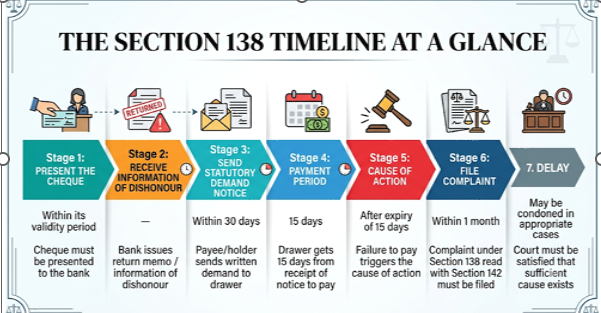
The Supreme Court has repeatedly emphasized the importance of these statutory stages.
Step 1: Present the Cheque Within Its Validity
The first question is simple:
How long is a cheque valid?
The first step is to deposit the cheque within its validity period.
Although Section 138 of the Negotiable Instruments Act refers to six months or the cheque’s validity period, whichever is earlier, the RBI has directed banks not to honour cheques presented after three months from the date of the cheque.
Therefore, a cheque should generally be presented within three months from its date.
Example:
If a cheque is dated 1st September 2026, it should ordinarily be presented on or before 1st December 2026.
Step 2: The Cheque Gets Dishonoured
Suppose the cheque is presented on 10th September 2026 and the bank returns it unpaid.
The bank will generally issue a cheque return memo, recording the reason for dishonour.
Common reasons may include:
Insufficient funds
Account closed
Payment stopped by drawer
Exceeds arrangement
Signature-related issues, depending on the circumstances
Other banking/technical reasons
Not every banking return automatically results in criminal liability under Section 138. The statutory requirements and the nature of the dishonour must be examined in the context of the transaction.
The important date for the next step is when the payee receives information from the bank regarding the return of the cheque unpaid.
Step 3: The Debt Must Be Legally Enforceable
A bounced cheque is not enough by itself.
Section 138 applies where the cheque was issued towards a legally enforceable debt or liability. Before initiating proceedings, verify the underlying transaction, invoice, agreement, delivery records, ledger, acknowledgment of debt, or other supporting documents.
Step 4: Who Can Be Held Personally Liable?
A cheque may be issued by a company, but recovery action does not necessarily stop with the company.
Where the drawer is a company, Section 141 of the Negotiable Instruments Act may make certain individuals liable for the offence, particularly those who were in charge of and responsible for the conduct of the company’s business at the relevant time.
So, before issuing the legal notice, identify:
Who signed the cheque?
Who was responsible for the company’s business?
What was the signatory’s role when the cheque was issued and dishonoured?
What documents or records establish that responsibility?
Important: Being a director or office-bearer, by itself, does not automatically establish personal liability. The complaint should contain the necessary factual basis showing the person’s role and responsibility.
Step 5: Before You Send a Section 138 Notice:
5 Checks
☐ Is the cheque still within its validity period?
☐ Do you have the bank return memo?
☐ Has the 30-day notice deadline been calculated?
☐ Is there a legally enforceable debt/liability supporting the cheque?
☐ Have you correctly identified the drawer and, where relevant, the persons who may be proceeded against?
One missed detail can affect the next step in the recovery process.
Step 6: Send the Legal Notice Within 30 Days
This is one of the most important deadlines under Section 138. The payee or holder in due course must issue a written demand notice within 30 days from receiving information from the bank regarding the dishonour.
The notice should demand payment of the cheque amount.
Example
10th September 2026: Cheque dishonoured
11th September 2026: Payee receives bank's dishonour information
The statutory notice should ordinarily be issued within 30 days from 11th September 2026.
This is where businesses sometimes lose valuable time.
The accounts team may wait for another reminder.
The sales team may call the customer.
The customer may promise:
"I'll clear it next week."
And suddenly, several weeks have passed.
That can create serious limitation issues.
Step 7: The Drawer Gets 15 Days to Make Payment
Sending the legal notice does not mean that the cheque bounce case can immediately be filed.
The drawer 15 days from receipt of the statutory notice to make payment of the cheque amount. gets Section 138 expressly provides this period.
Example
Suppose the drawer receives the notice on:
20th September 2026
The drawer has the statutory period to make payment.
If the cheque is paid within the prescribed period, the foundation for prosecution under Section 138 amount on that dishonour is not triggered in the same manner.
But if the drawer does not pay?
That brings us to the next stage.
Step 8: When Does the Cause of Action Arise?
This is where the timeline becomes legally important.
The offence under Section 138 is not complete merely because the cheque bounced. The drawer must also fail to make payment within the prescribed 15-day period after receipt of the statutory notice.
The Supreme Court has explained that the cause of action arises after the drawer fails to make payment within the statutory period.
So the sequence is:
Cheque dishonour → Notice → 15-day payment period → Failure to pay → Cause of action
Only after this stage does the limitation period for filing the complaint under Section 142(b) begin.
Step 9: File the Complaint Within One Month
Once the cause of action arises, the payee or holder in due course generally has one month to file the complaint under Section 142.
Section 142 requires the complaint to be made in writing by the payee or holder in due course and provides the limitation framework for complaints under Section 138.

What If the Legal Notice Is Not Accepted?
A common situation looks like this:
"The courier came, but the drawer refused to accept the notice."
Not necessarily.
The Supreme Court in C.C. Alavi Haji v. Palapetty Muhammed & Anr., (2007) 6 SCC 555 considered the issue of service of notice.
The Court recognized the presumption of service where the notice is sent to the correct address through registered post, subject to the circumstances and proof available in the case.
Therefore, maintaining proper proof of dispatch and the address used becomes extremely important.
Keep records of:
Copy of the legal notice
Postal receipt
Tracking report
Returned envelope, if any
Courier proof
Email delivery records, where relevant
WhatsApp/service records, where legally appropriate
The address used for service
A legal notice should not be treated as merely a formality. Documentation matters.
Can the Cheque Be Presented Again?
Yes, this is an important practical point.
Suppose a cheque is dishonoured once, but the cheque is still valid.
The payee may, depending on the circumstances, re-present the cheque.
The Supreme Court's decision in MSR Leathers v. S. Palaniappan, (2013) 1 SCC 177 is particularly important here.
The Court held that a fresh cause of action can arise when a cheque is presented again, dishonoured again, followed by the statutory notice and failure to make payment in accordance with Section 138. The judgment overruled the earlier position in Sadanandan Bhadran v. Madhavan Sunil Kumar.
Example
A ₹5 lakh cheque is dishonoured on 5 September.
The drawer requests:
"Please deposit it again next month. Funds will be available."
The payee agrees.
The cheque is re-presented while still valid and is dishonoured again.
Depending on the circumstances, the subsequent dishonour may provide the basis for following the Section 138 process afresh.
But this should not be misunderstood as permission to ignore limitation.
A business should carefully monitor the cheque's validity and the statutory deadlines associated with each presentation.
Can You File the Case Before 15 Days Are Over?
No.
This is one of the most common mistakes.
Suppose the drawer receives the statutory notice on 20th September.
The payee files the Section 138 complaint on 25th September.
The problem?
The 15-day payment period has not yet expired.
In Yogendra Pratap Singh v. Savitri Pandey & Anr., (2014) 10 SCC 713, a three-judge Bench of the Supreme Court held that a complaint filed before expiry of the 15-day period is not maintainable because the cause of action has not yet arisen.
The Court further explained that merely because the 15-day period expires while the complaint is pending does not cure the premature filing.
What If You Miss the One-Month Filing Deadline?
Section 142 does provide some flexibility.
If the complaint is not filed within the prescribed one-month period, the court may take cognizance if the complainant satisfies the court that there was sufficient cause for the delay.
However, this should not be treated as a routine extension.
The safer approach is:
Calculate the limitation period immediately and file within time.
Do not build a recovery strategy around the possibility of condonation
A Real-Life Style Business Example
Consider a manufacturer that supplies products worth ₹18 lakh to a distributor. The distributor repeatedly assures the manufacturer: "Payment will be made next week." After several reminders, the distributor issues a cheque for ₹18 lakh.
The cheque bounces.
The manufacturer now has two choices.
Approach A: Keep waiting
The manufacturer keeps calling.
Another promise is made.
Then another.
Two months later, the company checks the cheque bounce dates and discovers that the statutory notice period has already become an issue.
Approach B: Run recovery and limitation simultaneously
The manufacturer:
Collects the cheque and bank return memo.
Records the exact date of dishonour information.
Calculates the 30-day notice deadline.
Issues the statutory demand notice.
Tracks service.
Gives the drawer the statutory 15-day period.
Calculates the cause-of-action date.
Prepares the Section 138 complaint within the prescribed limitation period.
Continues settlement discussions wherever commercially appropriate.
The second approach creates a documented recovery trail while preserving the statutory remedy.
Section 138 Is Not Simply a "Cheque Bounce = Case" Formula
It is important to understand that Section 138 has several statutory ingredients.
Among other things, the cheque must relate to payment of a legally enforceable debt or other liability, and the statutory conditions concerning presentation, notice and payment must be satisfied. Section 138 also prescribes the potential punishment, which can extend to imprisonment of up to two years, or fine up to twice the cheque amount, or both.
Therefore, businesses should preserve the underlying transaction documents.
Depending on the transaction, these may include:
Invoices
Purchase orders
Agreements
Delivery challans
E-way bills
Goods receipt notes
Ledger statements
Emails
WhatsApp communications
Account confirmations
Payment commitments
Bank statements
The original cheque
Bank return memo
Legal notice and proof of service
The cheque is only one part of the evidentiary picture.
The 30–15–30 Rule: Remember It Like This
If you remember only one thing from this article, remember:
30 → 15 → 30
30 Days
Issue the statutory demand notice within 30 days from receiving information of cheque dishonour.
↓
15 Days
↓
30 Days / One Month
After the cause of action arises because payment was not made, the complaint should ordinarily be filed within one month, subject to the statutory provision for condonation of delay for sufficient cause.
This simple framework can prevent costly limitation mistakes.
Common Mistakes in Cheque Bounce Cases
1. Waiting too long before sending the notice
A business may spend weeks negotiating verbally.
Problem: The 30-day notice period continues to run.
2. Filing the complaint too early
The notice has been sent, but 15 days have not expired.
Problem: The cause of action has not yet arisen.
The Supreme Court's decision in Yogendra Pratap Singh makes this particularly clear.
3. Assuming the cheque has six months of validity
The NI Act contains older wording referring to six months or validity, whichever is earlier, but RBI directions since 2012 require banks not to make payment on cheques presented beyond three months.
4. Losing proof of service
Sending a notice is only one part of the process.
Proof of dispatch, tracking and service can become important later.
5. Failing to preserve the underlying transaction documents
A cheque does not exist in a vacuum.
The underlying legally enforceable liability may need to be established.
6. Treating settlement discussions as a substitute for legal action
A debtor may genuinely need more time or may simply be delaying.
Commercial negotiations can continue, but statutory deadlines should be tracked separately.
How LegalPay Can Help?
For businesses, cheque bounce is rarely an isolated legal problem.
Usually, it is part of a larger accounts receivable and debt recovery cycle:
Invoice Raised → Payment Due → Reminder → Reconciliation → Escalation → Formal Demand → Negotiation/Settlement → Legal Recovery → Closure
This is where LegalPay Technology Private Limited can assist businesses in managing the recovery process.
LegalPay works in the dispute resolution and financial recovery space, helping businesses move from pre-litigation recovery efforts to formal legal action where required.
Depending on the matter, the recovery process can involve:
1. Initial debtor communication
Structured calls, emails and payment follow-ups can be used to understand the reason for non-payment and establish the debtor's willingness and ability to pay.
2. Debt validation and reconciliation
Before escalating a matter, the outstanding amount can be reviewed against invoices, ledgers, payments, credit notes and other relevant records.
3. Legal notice
Where appropriate, a formal demand/legal notice can be issued, clearly setting out the outstanding amount and the consequences of continued non-payment.
4. Settlement and payment arrangements
Not every recovery has to immediately become a courtroom dispute.
Where commercially appropriate, structured settlement discussions and payment arrangements can be explored.
5. Cheque bounce proceedings
Where the statutory requirements are satisfied and payment remains unpaid, appropriate legal proceedings under the Negotiable Instruments Act can be considered.
6. Litigation and recovery support
For matters requiring escalation, LegalPay can support businesses through the appropriate legal recovery process, including litigation-oriented recovery strategies.
Don't Let a Bounced Cheque Become a Missed Limitation Deadline
A bounced cheque is frustrating.
But the bigger mistake is allowing frustration, repeated promises or informal negotiations to make you miss the statutory timeline.
The sequence is straightforward:
Present the cheque within validity → Act within 30 days of dishonour information → Give the drawer 15 days after receipt of notice → Wait for the cause of action to arise → File the complaint within one month, subject to applicable law and any condonation of delay.
For businesses dealing with repeated delayed payments, the objective should not simply be to react after a cheque bounces. A structured receivables recovery process can help identify overdue accounts early, document the debt, engage with the debtor, preserve legal remedies and escalate appropriate matters within time.
LegalPay Technology Private Limited helps businesses navigate this recovery journey
from pre-litigation engagement and formal demands to settlement and legal recovery.
When the cheque bounces, act promptly, preserve your rights, and keep your recovery moving.
Frequently Asked Questions (FAQ)
Q1. How many days do I have to send a cheque bounce legal notice?
The statutory demand notice under Section 138 must generally be issued within 30 days from receipt of information from the bank regarding the dishonour of the cheque.
Q2. How many days does the drawer get after receiving the notice?
The drawer gets 15 days from receipt of the notice to make payment of the cheque amount.
Q3. Can a cheque bounce case be filed immediately after sending the notice?
Generally, no. The 15-day statutory payment period must expire without payment before the cause of action arises. The Supreme Court addressed premature complaints in Yogendra Pratap Singh v. Savitri Pandey.
Q4. How long do I have to file a Section 138 complaint?
The complaint should ordinarily be filed within one month from the date the cause of action arises, subject to the statutory provision permitting condonation where sufficient cause for delay is established.
Q5. Is a cheque valid for six months?
In practice, cheques are generally required to be presented within three months. RBI directed banks not to make payment on cheques presented beyond three months from the date of the instrument, effective from 1 April 2012.
Q6. Can a bounced cheque be presented again?
Yes, depending on the circumstances and while the cheque remains valid. The Supreme Court in MSR Leathers v. S. Palaniappan recognized that successive presentations followed by the statutory requirements can give rise to a fresh cause of action.
Q7. What if the recipient refuses to accept the legal notice?
Refusal or non-acceptance does not necessarily defeat service. The Supreme Court in C.C. Alavi Haji v. Palapetty Muhammed discussed the presumption of service when notice is properly sent to the correct address. The facts and proof of dispatch/service remain important.

Comments